
UK Employers Adjust to New Levy and Apprenticeship Rules
The UK government, in the Autumn 2025 Budget released in November, announced major expansions to youth apprenticeships. Chancellor Rachel Reeves revealed that the government will invest £725 million over the next three years into the scheme.
The expansion will fund apprenticeships for under 25s in AI, hospitality, and engineering, and will also remove the 5 percent co-investment levy for small and medium sized businesses. The vision is to make apprenticeships training more accessible.
What else was included in this announcement, let’s take a look in this detailed blog.
A Renewed Focus on Apprenticeships
The number of young people starting apprenticeships has fallen by almost 40% over the past decade. This is why the government had to focus on this area and place apprenticeship training back at the forefront of youth employment strategy.
Speaking about his personal connection to apprenticeships, Sir Keir Starmer highlighted the value of vocational training. He shared that his father had trained as a tool-making engineer through night school, emphasizing that apprenticeships are “every bit as valuable as going to university.”
Sir Keir added:
“University is a good thing to do, I’m not going to knock it, that’s what I did, but being an apprentice is an equally good thing to do, that’s what my dad did and he was a highly skilled engineer and tool-maker.”
Changes for Levy Paying Employers
One of the biggest changes in the recent Autumn 2025 Budget was the update to the apprenticeship levy. Larger organisations that pay the levy will see several important changes.
1. Firstly, employers will now have 12 months to use their levy funds instead of 24 months. Any money that is still unused after 1 year will be removed from the account.
2. The government is removing the 10 percent top up that used to be added to levy accounts. Employers will now rely only on the amount they pay in themselves.
3. When a company runs out of levy funds, its share of training costs will increase. This share used to be 5 percent. Under the new rules, the employer portion will rise to 25 percent.
These changes are significant. Sunesis recommends that large employers check their digital levy accounts regularly, keep track of expiry dates, and plan their apprenticeship activity so that funds are used on time. This will help prevent extra expenses from appearing unexpectedly.
Apprentice Minimum Wage in UK
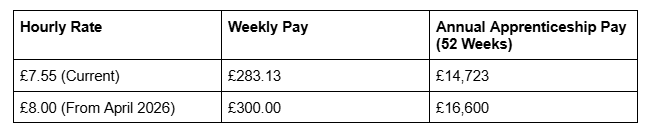
Apprentice pay rates have also been updated. From April 2026, the UK national minimum wage will increase from £7.55 to £8.00 per hour, and a full time apprentice working 37.5 hours. Here is how the change in national wage will affect weekly and annual pay compared to the current rates.
Shorter, Modular Apprenticeship Courses
The government is also focusing on creating shorter apprenticeship units. The goal is to help employees build skills in areas such as AI, digital work, and engineering. These units are funded through the Growth and Skills Levy and are designed to help employers fill skills gaps more quickly.
Employers will be able to use these short modules to train staff in specific areas without committing to a full apprenticeship. The Department for Education will share more guidance on how these modules will sit alongside current apprenticeship standards.
How the Changes Affect Young People
The new changes to the apprenticeship wage and policies offer several clear advantages for apprentices under 25. Training and assessment will be free for those in SMEs, and the 5 percent co investment levy will be removed, which lowers costs for small employers.
New apprenticeship pathways will open in areas facing serious skills shortages, including AI, hospitality, and engineering. From spring 2026, short courses and modular training will also be available to help apprentices. The first year apprentice wage current minimum wage of £7.55 per hour will also increase to £8.00 per hour in April 2026.
According to Skills Minister Baroness Jacqui Smith, these updates aim to reverse the decline in youth apprenticeships over the past decade and support young people in accessing stable, high quality work.
Looking Ahead to Future Opportunities
With nearly a million young people out of work or education, the government’s apprenticeship expansion is a major investment in skills and youth employment. The reforms aim to make apprenticeships more accessible and flexible, while focusing on industries with skills shortages and supporting SMEs and local employers.
As a UK’s leading apprenticeships management platform, Sunesis believes these policies were necessary, given the declining number of apprentices. If you want to invest in improving employees’ skills, access to training must be enhanced. With these new policies, SMEs and new apprentices can benefit from easier entry into apprenticeship programs and more support.
That’s what we at Sunesis strive for with our platform. We ensure that all apprenticeship training programs are facilitated and everyone can be managed efficiently through a single apprenticeship management platform.